
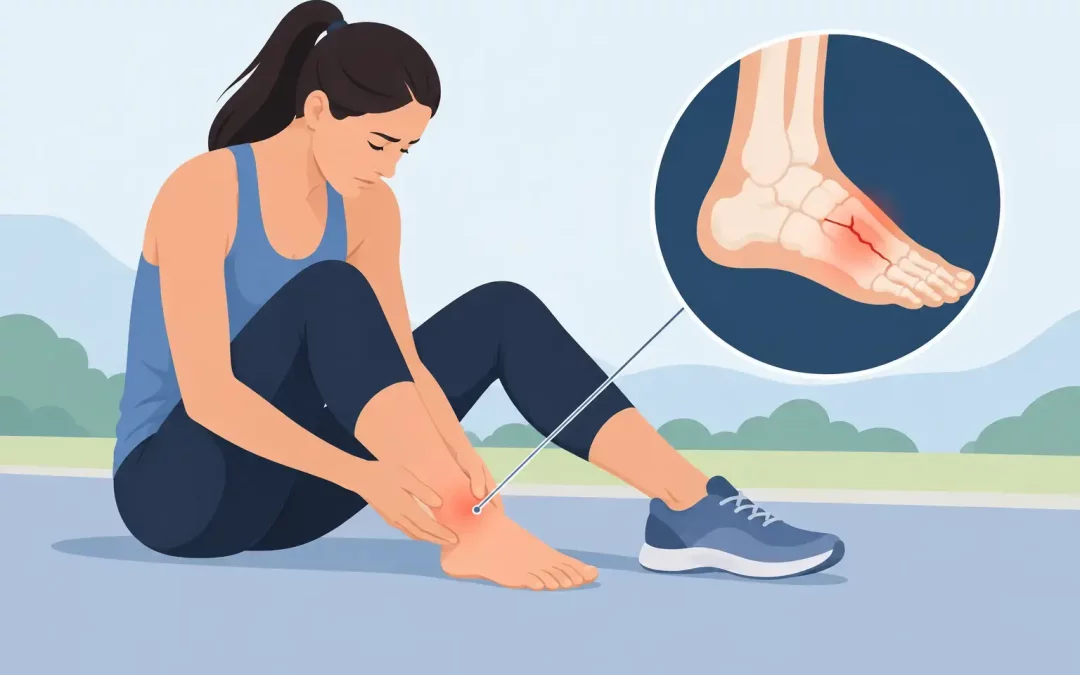
A stress fracture rarely announces itself with one dramatic moment. More often, it starts as a nagging ache during a run, a sore spot after practice, or pain that seems small enough to push through. Stress fracture foot symptoms can feel deceptively manageable at first, but continuing to train on a bone that is breaking down can turn a minor injury into a longer interruption from the activities you love.
For runners, soccer players, hikers, dancers, and active adults across the Front Range, the goal is not simply to stop pain for a day. It is to identify the injury early, protect healing bone, and address why the overload happened so you can get back in the game safely.
What Is a Stress Fracture?
A stress fracture is a small crack in a bone caused by repetitive loading rather than a single collision or fall. Bone is living tissue. It normally adapts to training by remodeling itself, but it needs enough recovery time to keep pace with the force placed on it.
When mileage rises quickly, practices become more intense, footwear changes, or mechanics place too much pressure on one area, tiny areas of bone damage can accumulate faster than the body can repair them. In the foot, the metatarsals – the long bones behind the toes – are common locations. Stress injuries can also occur in the navicular bone near the top of the midfoot, the heel, and other areas that require careful management.
Stress Fracture Foot Symptoms to Watch For
The most recognizable symptom is pain in one specific location. Unlike general post-workout soreness, stress fracture pain is often easy to pinpoint with one finger. It may begin only after a certain distance, late in practice, or during jumping and push-off.
As the injury progresses, pain tends to arrive sooner and linger longer. A run that used to hurt only near the end may become painful during warm-up. Eventually, walking, standing at work, or even resting can become uncomfortable.
Other common stress fracture foot symptoms include mild swelling over the painful bone, tenderness when pressing directly on the area, and discomfort when hopping or pushing off the forefoot. Bruising may occur, but its absence does not rule out a fracture. Some athletes notice a subtle change in gait before they realize how much they are compensating.
Pain on the top of the foot deserves particular attention, especially when it is focused over a metatarsal or the midfoot. So does pain along the outside of the foot near the base of the fifth metatarsal. These locations can involve injuries with different healing demands, so guessing based on symptoms alone is not the right play.
The Pattern Matters More Than Your Pain Tolerance
A stress fracture does not have to produce severe pain to be significant. Highly motivated athletes are often skilled at working around discomfort, and that determination can delay diagnosis. If pain consistently returns when you run, cut, jump, or hike, your body is giving you useful information.
A helpful distinction is whether the pain improves as you warm up. Tendon and muscle issues sometimes feel stiff initially and then loosen with activity. Stress fracture pain is more likely to build with impact and worsen after activity, although every injury can present somewhat differently. A sports-focused foot and ankle evaluation can sort out the difference.
Why Stress Fractures Happen
Training volume is only part of the equation. A stress fracture may follow a sudden increase in mileage, hill training, tournament play, plyometrics, or time on hard surfaces. It can also occur when an athlete returns to sport too quickly after time away.
Biomechanics matter. High arches, excessive pronation, limited ankle mobility, calf tightness, leg-length differences, and inefficient running form can shift repeated force to a small area of the foot. Worn-out shoes, poorly matched soccer cleats, or a change in footwear can add to that load.
Recovery factors matter just as much. Low energy availability, inadequate protein or calcium intake, low vitamin D, poor sleep, hormonal changes, certain medications, and reduced bone density can affect bone health. This does not mean every stress fracture signals a serious health problem. It does mean a complete assessment should look beyond the painful spot, particularly if fractures recur.
When Foot Pain Needs Prompt Evaluation
Do not wait for a limp or severe swelling to take localized foot pain seriously. An early evaluation may identify a bone stress reaction before it becomes a complete stress fracture, often making treatment more straightforward.
Seek prompt care when pain is localized and worsening with impact, when you cannot hop comfortably on the affected foot, or when pain persists despite several days away from training. Evaluation is especially urgent if you have pain at rest, night pain, increasing swelling, numbness, or difficulty bearing weight.
Some foot stress fractures occur in higher-risk areas where blood supply and biomechanics can make healing more challenging. Pain in the middle of the top of the foot or on the outside border of the foot should not be managed with a wait-and-see approach. Continuing to play through these injuries may raise the risk of a more serious fracture or delayed healing.
Why an X-Ray May Not Give the Full Answer
A standard X-ray is often an appropriate first step, but early stress fractures may not show up right away. Bone changes can take time to become visible on radiographs. A normal early X-ray does not automatically clear an athlete to continue impact activity when the history and exam still point to a stress injury.
Depending on your symptoms and exam, advanced imaging such as an MRI may be used to identify bone stress earlier and define the severity of the injury. This is not about ordering tests unnecessarily. It is about getting a clear diagnosis when the answer changes how you train, how much weight you can bear, and how soon you can return to sport.
Treatment Is Active, Not Passive
The right treatment depends on the bone involved, the severity of the injury, your current pain, and the demands of your sport. Many stress fractures heal well with a period of reduced impact, protective footwear or a walking boot, and a structured return-to-activity plan. Some require stricter non-weight-bearing protection, and a smaller number may need surgical consideration.
Rest from running does not always mean doing nothing. Once your specialist determines what is safe, lower-impact conditioning such as swimming, cycling, or pool running may help preserve fitness. The trade-off is that cross-training must not recreate the same painful load. If it hurts, it is not the right substitute yet.
A full treatment plan should also address the reason the injury developed. That can include gait analysis, footwear or cleat assessment, targeted mobility and strength work, nutritional guidance, and custom orthotics when foot mechanics are contributing to overload. The objective is not merely to heal this fracture. It is to reduce the chance that the next training block produces the same problem.
Returning to Running and Sport
Return-to-play timelines vary. A low-risk metatarsal stress injury diagnosed early may recover differently than a navicular or fifth-metatarsal injury. Healing also depends on whether you protected the bone early or continued to load it through pain.
Before returning to impact, you should be able to walk comfortably and complete the functional milestones your clinician recommends without focal pain. Running progression should be gradual, with rest days and close attention to symptoms. A pain-free hard workout is not the same as full recovery if soreness returns later that day or the following morning.
At Colorado Center for Podiatric Sports Medicine, we treat every patient as an athlete, whether your next goal is a race, a full soccer season, a pain-free hike, or simply moving through your workday without guarding your foot. A precise diagnosis gives you a better path forward than trying to tough it out.
Your foot is built to carry you a long way. When one small spot keeps asking for your attention, listen early – and give it the expert plan it needs to carry you back to what you do best.

Recent Comments